
Start here if your goal is to speak more often. PolyglotClub Paris meetups are informal, free to join, and useful for speaking with French locals, English speakers, expats and travellers.

Start speaking before you feel ready
Grammar and apps help, but French becomes useful when you use it with real people. In Paris, combine a class, a free resource and a weekly conversation habit. Your goal is not perfect French; it is regular French.
Why learning French in Paris can still feel difficult
Paris gives you many chances to hear French, but that does not automatically make speaking easy. Many newcomers spend their day in English at work, study French alone in the evening, and then feel blocked when a real conversation starts. The speed, the accent, the small everyday expressions and the fear of making mistakes can make even simple situations feel stressful.
This is why passive exposure is not enough. You need regular, low-pressure speaking situations where you can try, hesitate, ask for repetition and continue. French becomes easier when it stops being only a course or an app and becomes something you use with people every week.
The practical method: one structured resource plus one real conversation
A class, a public workshop or a self-study website gives you structure. It helps you understand grammar, pronunciation and vocabulary. But structure alone does not create confidence. Confidence comes when you use the same words in a real exchange, with someone reacting naturally in front of you.
A good weekly routine is simple: choose one resource to study, prepare a few sentences, then test them in a meetup. After the conversation, write down the words you missed and review them the next day. This short loop is more useful than collecting too many apps, books or courses without speaking.
How to use a PolyglotClub evening to improve your French
A PolyglotClub evening is not a formal French class, and that is exactly why it helps. You meet different people, hear different accents, switch topics and practise the kind of small conversation that happens in real life. You can start slowly, listen first, and then use short sentences when you feel ready.
Before coming, prepare three useful phrases: who you are, why you are in Paris, and one question to ask. During the evening, ask people to speak slowly and repeat useful expressions. After the meetup, keep five words or phrases and reuse them the next time. This makes the evening a real learning tool, not only a social event.
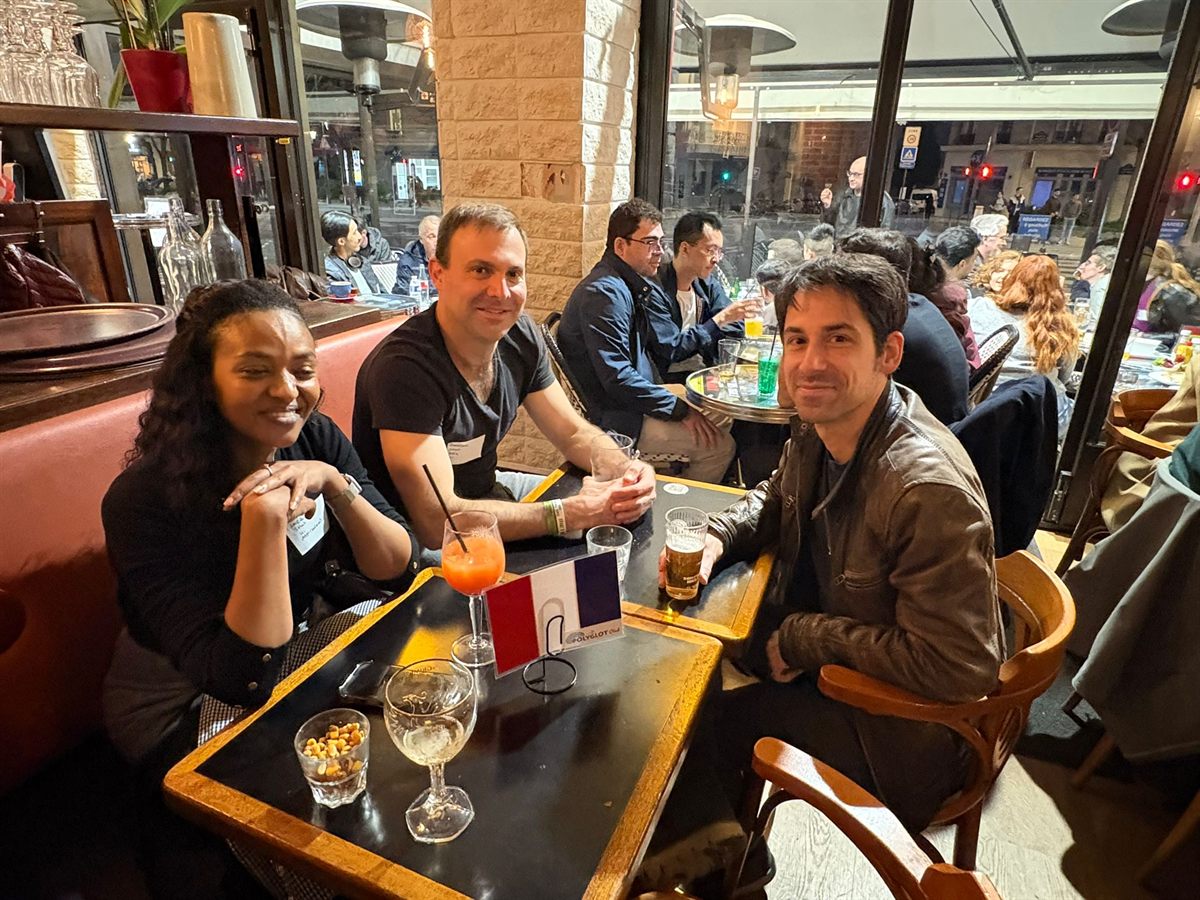
First recommendation: PolyglotClub Paris meetups
Use the hub to check the Paris community, upcoming dates and the latest practical information before going.
Useful for announcements, quick questions and keeping contact after a meetup.
A simple routine that works
Goal: arrive with something concrete to say, even if your French is basic.
- Choose one easy topic: work, studies, food, travel, neighbourhood, hobbies or why you live in Paris.
- Prepare 3 short sentences in French about that topic.
- Prepare 2 simple questions to ask other people.
- Keep one backup sentence ready: Vous pouvez répéter plus lentement ? or Comment dit-on ... en français ?
- Read your sentences before entering, then put the phone away and try to speak.
Goal: speak more, not perfectly.
- Start with one simple sentence to break the ice.
- Ask your first question in the first 2 minutes.
- If you are blocked, rephrase with easier words instead of switching immediately to English.
- Ask for one correction on one sentence, not on everything you say.
- Change person or table to hear several accents and speaking speeds.
Goal: turn the evening into measurable progress.
- Write down 5 French words or expressions you needed but did not know.
- Write down 1 sentence you managed to say.
- Check only the most useful corrections; do not try to review everything.
- Say 3 new sentences out loud using those words.
- Decide what you will test again at the next meetup.
Goal: build a routine you can actually keep.
- One real conversation: PolyglotClub, a workshop or a local meetup.
- One 20-minute listening session: RFI, TV5MONDE, a short video or a library resource.
- One 10-minute review: the words you wrote down during the week.
- One mini-preparation: 3 sentences and 2 questions for the next conversation.
- Drop resources you never open so your system stays simple.
9 useful resources to learn French in Paris
These resources are useful because they help you speak, listen, read, find a class or get oriented in Paris.

Conversation
PolyglotClub Paris
See meetupsThe first place to practise spoken French with real people. Come with two simple sentences, ask for slower speech, and switch tables when you need new practice.

Official guide
Ville de Paris - Learn French
Open the guideOfficial overview of French learning options in Paris. Use it to understand the public and associative routes before choosing a course.

Public courses
Cours d'Adultes de Paris
See adult coursesUseful for structured evening learning. Check registration windows carefully because places and dates change.

Conversation workshop
Bpi - French workshops
See Bpi workshopsFree workshops and self-study methods for foreigners learning French. Good complement to informal meetups.

Self-study and workshops
CIUP - Espace langues
Open CIUPUseful for students, researchers and international residents: self-study, French workshops and conversation groups.

Library resources
Bibliotheques de Paris
See language resourcesA practical free route for online language modules, reading practice and quiet study between conversation sessions.

Orientation
Reseau Alpha
Find a courseA strong directory to find French classes and sociolinguistic workshops in Paris and Ile-de-France.

Online exercises
TV5MONDE Apprendre
Practise onlineFree exercises by level. Use it for listening and vocabulary, then reuse new words at a meetup.

Listening practice
RFI Francais facile
Listen to RFIGood for training your ear with slow news, exercises and real spoken French.
A simple 4-week plan
Goal: speak French at least once with a real person.
- Put one PolyglotClub meetup or conversation workshop in your calendar.
- Prepare 5 phrases: introduction, level, why you learn French, asking someone to repeat, one simple question.
- On the day, speak for 10 minutes with two different people.
- Do not try to understand everything; keep the conversation moving.
- After the meetup, write down 5 missing words and 1 situation where you got stuck.
Goal: add structure without scattering your attention.
- Choose one main resource: Bpi, Bibliothèques de Paris, CIUP, Reseau Alpha, TV5MONDE or RFI.
- Block two 30-minute sessions during the week.
- Session 1: listening or reading, with 10 useful words maximum.
- Session 2: turn those words into 5 personal sentences.
- Test at least 2 of those sentences in a real conversation.
Goal: expose yourself to living French in Paris.
- Choose a local situation: a meetup, a cafe interaction, a library activity or a public workshop.
- Collect 3 natural expressions French speakers really use.
- Ask at least 2 questions in French, even very simple ones.
- Notice what people understand and what you need to rephrase.
- Reuse those expressions at the next PolyglotClub evening.
Goal: keep only what works.
- Review what actually made you speak French.
- Keep 3 fixed weekly appointments: one conversation, one listening session, one short review.
- Set a measurable goal for the next month: 4 meetups, 20 useful new words, 10 short conversations.
- Remove resources you never open.
- Come back each week with one new sentence to test.
Frequently asked questions
Can beginners come to PolyglotClub?
Yes. You can listen first, use simple sentences and ask people to slow down.
Are cafes, bars and daily life enough to learn French?
They help with immersion, but they are not enough on their own. You also need intentional practice: ask questions, rephrase, ask for slower speech and come back regularly to real conversations.
Should I take a course or just talk?
Use both. A course gives structure; conversation turns it into reflexes.
What is the best free option?
For speaking, try PolyglotClub or a conversation workshop. For self-study, use TV5MONDE, RFI and public libraries.
What are the benefits of learning in person?
In-person practice forces you to react in real time: you hear different accents, learn to rephrase, gain confidence and receive natural corrections. For spoken French, this is often what is missing when you only use an app.
Is it a good idea to learn only with AI?
AI can help you prepare sentences, correct a text or simulate a dialogue. But it does not replace real conversation: hesitation, accents, background noise, spontaneous reactions and social confidence are better trained with real people.
What should I do if I am a complete beginner?
Start with a very small goal: say hello, introduce yourself, explain that you are beginning and ask one short question. Prepare these phrases before coming, keep them on your phone, then ask people to speak slowly. You can also listen for a few minutes before speaking.
What if I do not know anyone at a polyglot meetup?
Come anyway. The meetups are designed for meeting new people through languages. Arrive early if possible, say it is your first time, sit at a table and start with a simple question such as: which language do you want to practise tonight?
How often are PolyglotClub Paris meetups organised?
PolyglotClub Paris usually offers regular meetups, especially on Tuesdays and Saturdays. Venues, times and formats can change, so always check the official event page before coming.
Which meetup should I choose to learn French?
Choose a meetup where you can speak with French speakers, Parisians, expats and other motivated learners. PolyglotClub Paris works well because you can change tables, test simple sentences and practise several times during the same evening.